
Parents often notice the clues first: your child sits closer to screens, squints at the board, or complains that distant signs look blurry. The big question is what those changes mean—and whether nearsightedness is likely to keep increasing over time. This guide is for parents and caregivers who want clear, practical steps for recognizing and responding to myopia progression so kids can see comfortably at school, in sports, and at home.
As fall routines ramp up—sports, homework, and more screen time—vision demands can climb, and subtle changes can become easier to spot. A structured plan (including a comprehensive eye exam) helps you separate normal growing pains from vision changes that deserve attention.
If you’re looking for next-step care locally, you can schedule a visit through this myopia progression evaluation in Greensboro, GA page.
Key Points to Know First
- Myopia progression means nearsightedness increases over time, often during childhood growth years.
- Common signs include squinting, moving closer to screens, headaches after distance viewing, or difficulty seeing the board.
- A comprehensive eye exam is the safest way to confirm what’s changing and rule out other causes of blur.
- Daily habits (lighting, outdoor time, and screen breaks) can support visual comfort and healthy routines.
- If you already have glasses, worsening distance blur or frequent prescription changes are reasons to re-check sooner.
How Nearsightedness Changes Over Time in Children
Myopia happens when the eye focuses images in front of the retina instead of directly on it—often because the eye is longer than average from front to back. In kids, the eye is still growing, so prescriptions can change as the visual system develops.
Myopia progression is not something you can accurately track by “guessing” at home. Kids can compensate by squinting, moving closer, or avoiding distance tasks—so the change may look like behavior or attention issues. A comprehensive eye exam provides measured vision and prescription testing, and it gives a clinician a chance to look at overall eye health.
Typical progression patterns (what research commonly shows)
Every child is different, but myopia often begins in early school years and can progress through the later teen years as the eye grows. Progression tends to be faster in younger children and may slow down in later adolescence. Earlier onset generally means more years for myopia to change, which is one reason early evaluation and a clear follow-up plan matter.
Key risk factors parents can’t always see
- Family history: having one or both parents with myopia increases a child’s likelihood of developing it and may be associated with higher risk of progression.
- High near-work load: long stretches of reading, tablets, phones, or homework without breaks can increase visual strain and is associated with myopia development/progression in many studies.
- Limited outdoor time: more time outdoors is consistently associated with a lower risk of developing myopia; it may also help reduce progression risk for some children.
Myopia control options: proven vs. emerging
Supported by a strong body of evidence (commonly used in clinical practice):
- More outdoor time: associated with reduced risk of developing myopia and may support healthier visual habits overall.
- Specialty contact lenses: certain designs (including orthokeratology worn overnight and specific soft multifocal designs) have evidence for slowing progression in many children.
- Low-dose atropine eye drops: supported by multiple studies as an option to slow progression for selected children, with dosing and monitoring guided by an eye doctor.
Helpful habits and areas still being studied (promising, but results vary):
- Near-work breaks and ergonomics: regular breaks, good lighting, and appropriate working distance can reduce strain; research continues on how much this changes progression rates.
- Device/behavior changes alone: reducing screen time may improve comfort and sleep routines, but it doesn’t replace measuring prescription changes and discussing control options when progression is documented.
What parents can observe (and what it might mean)
- Squinting at distance: can temporarily sharpen focus but often signals distance blur.
- Sitting close to the TV/tablet: may indicate near is clearer than far.
- Headaches after school: can be related to visual strain, but headaches have many causes—an exam helps clarify.
- Declining sports performance: difficulty tracking a ball or seeing teammates may be a distance-vision issue.
Why Timing Matters for School, Sports, and Confidence
Uncorrected or under-corrected distance vision can affect classroom learning (seeing the board), safety (biking, crossing streets), and enjoyment (sports and activities). When kids can’t see clearly, they may avoid tasks that feel frustrating—or they may not mention it because they assume everyone sees the same way.
From a parent’s standpoint, delays can also mean more trial-and-error: you might buy new glasses, only to find the prescription needs updating again sooner than expected. Planning regular check-ins and responding quickly to new symptoms can reduce surprises.
Common Missteps Parents Make (Checklist)
- Waiting for a failed school screening: screenings can miss issues or lack detail; they don’t replace a comprehensive eye exam.
- Assuming squinting is “just a habit”: squinting is often a functional workaround for blur.
- Stretching an old prescription too long: kids may not realize their vision has changed until it’s significantly worse.
- Skipping symptom details at the visit: mention headaches, eye rubbing, sitting close, and distance complaints—small clues add up.
- Over-focusing on screens as the only cause: screens can contribute to strain, but blur at distance still needs proper measurement.
A Parent-Friendly Plan to Support Clear Vision (Checklist)
- Schedule a comprehensive eye exam if your child squints, moves closer to see, or reports distance blur.
- Bring context to the appointment: when symptoms started, which settings are hardest (classroom, sports, nighttime driving for teens), and any family history you know.
- Ask what follow-up timing makes sense for your child’s age, prescription, and symptoms.
- Use simple screen habits: encourage regular breaks, comfortable lighting, and appropriate viewing distance.
- Prioritize outdoor play when possible: many families find that consistent outdoor time supports healthier routines overall.
- Check glasses fit and wear time: slipping frames or inconsistent wear can look like “the prescription isn’t working.”
Professional Insight: The Pattern Parents Miss
Many children don’t describe vision changes as “blurry.” They may say things like “it’s hard to see,” “my eyes are tired,” or “I can’t see the board unless I’m in the front.” Sharing specific examples (where it happens, when it started, and what your child does to cope—like squinting or moving closer) helps the exam focus on real-life needs, not just letter charts.
When to Seek an Eye Doctor’s Help
Use these decision points to choose the right timing:
- Same-day / urgent guidance: sudden vision change in one or both eyes, eye pain, new light sensitivity, new flashes/floaters, or a red eye with significant discomfort.
- Schedule within 1–2 weeks: new distance blur (board/TV/road signs), squinting that’s increasing, complaints that glasses “don’t work,” or headaches/eye strain that repeatedly show up after school.
- Routine visit (and don’t wait for a screening): if your child is due for an annual exam, has a family history of myopia, or you’re noticing mild but persistent changes in how they see or behave at distance.
- Follow up sooner than the usual schedule: if a teacher/coach reports new difficulty seeing, if your child’s prescription seems to change frequently, or if symptoms return quickly after a recent glasses update.
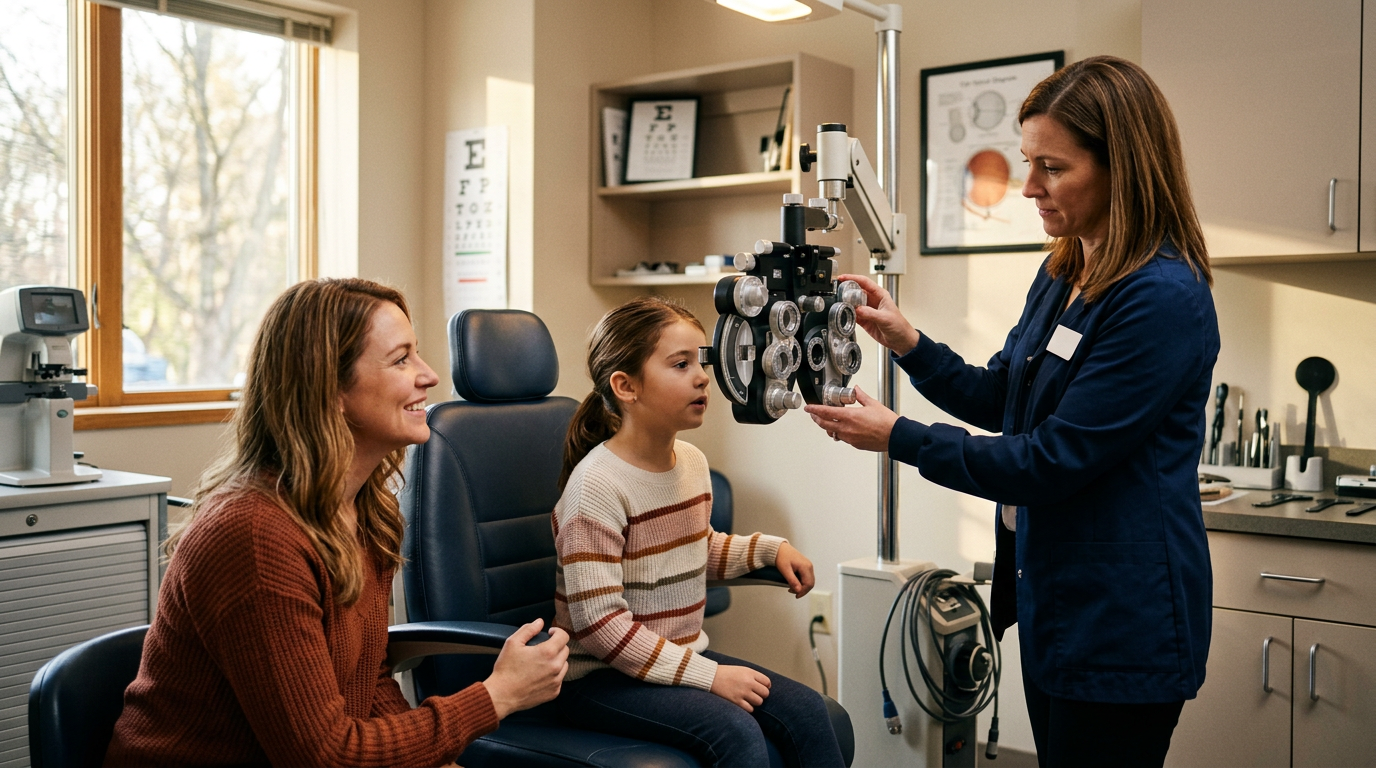
A comprehensive pediatric myopia evaluation commonly includes:
- Visual acuity testing (how clearly your child sees at distance and near)
- Refraction (measuring the glasses prescription; in many pediatric cases, this may include cycloplegic drops to relax focusing for a more accurate measurement)
- Binocular vision and focusing assessment (how the eyes work together and handle near tasks)
- Eye health evaluation (often including a dilated exam when appropriate)
- Discussion of risk factors and options (habits, follow-up timing, and whether myopia-control treatments are a fit)
Common Questions Answered
How do I know if my child’s prescription is changing?
If your child starts sitting closer, squinting more, or says distance targets look fuzzy even with glasses, it’s a good reason to schedule a comprehensive eye exam for updated measurements.
Can my child “outgrow” nearsightedness?
Some kids have stable prescriptions for periods of time, but many experience changes during growth years. An eye doctor can track changes over time and recommend an appropriate follow-up schedule.
Are headaches always caused by vision problems?
No. Headaches can have many causes. Vision strain can be one of them, which is why an eye exam is a useful step when headaches are frequent and associated with reading or distance viewing.
What should I bring to my child’s appointment?
Bring current glasses or contacts, a list of symptoms you’ve noticed, any previous prescriptions if you have them, and notes from teachers or coaches if they’ve observed vision-related challenges.
Taking Action
Clear distance vision affects how kids learn, play, and feel about their performance. If you’re concerned about myopia progression, the most practical next step is a comprehensive eye exam and a follow-up plan based on your child’s specific measurements and symptoms. Small, consistent habits—like screen breaks and good lighting—can also support day-to-day comfort.
Learn More About Our Services
If you’d like help sorting out whether your child’s nearsightedness is changing—and what follow-up or myopia-control options may be appropriate—schedule a pediatric myopia evaluation. Expect a full vision and eye-health assessment, a discussion of risk factors (like family history and visual habits), and a clear plan for monitoring over time.